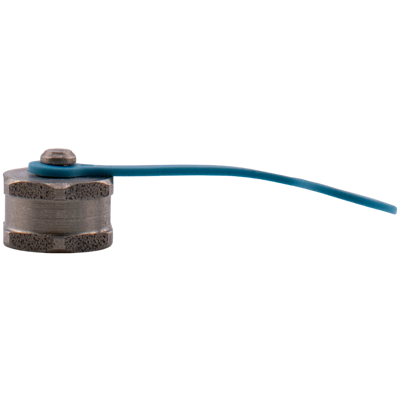
Images are representations only.
Description
In general, the Pete‘s Plug® is a time and money-saving device which is well-suited for most plant and pipeline systems and is designed to eliminate gauge cocks and thermometer wells. Hot and chilled water systems, heat exchangers, pumps, differential readings, air, gas lines and numerous other applications are only a few of the areas where the Pete‘s Plug® are presently being used.
Pete‘s Plug® will allow you to take pressure and temperature readings quickly and eliminate the need for leaving costly gauges or temperature indicators on the line. Depending on the application, the Pete‘s Plug® can be operated to a maximum of 1,000 PSI and 200° or 275°F (93°C or 135°C) for neoprene or nordel respectively. A maximum working pressure of 1,500 PSI can be obtained within the temperature ranges of 140° to -20°F (60°C to -29°C) within reasonable time frame to return the cap for a securely closed system.
How to Operate
The Pete‘s Plug® is permanently installed in the line at recommended test points. The cap protects the valve and provides an additional seal. After the cap has been removed, either a test thermometer or a gauge can be inserted through the two self-closing valves in the Pete‘s Plug®. Readings are made and adjustments or tests can be accomplished when the probes are withdrawn and the two valves close. The protective cap is then reinstalled. Tests should be made as quickly as possible since the valve reseal time is dependent upon time of insertion, time and pressure. Slower reseal time can be expected at a lower temperature and lower pressures.
Features
- Neoprene is a chloroprene-based synthetic rubber and it is resistant to deterioration from waxes, fats, oils, greases, petroleum products and most refrigerants.
- Nordel is an ethylene-propylene-based synthetic rubber and gives excellent service in hot and cold water and in some applications of low steam. Nordel is resistant to detergents, phosphate esters, ketone, alcohols and glycols.
Configure
Specifications
Specifications
Brand
Seal Type
- Neoprene
- Nordel
Length
- 1-1/2"
- 3"
- 1-1/5"
- 1-1/4"
Thread
- 1/4" NPT
- 3/8" NPT
- 9/16" NFT
- 1/2" NPT
- 3/4" - 16 NFT
- 1/4" BSP
- 1/8" NPT
Why Choose Pete's Plug Test Plugs
Why Choose Pete's Plug Test Plugs
Value Elements
Fast Pressure and Temperature Testing
Pete’s Plugs are permanently installed at key test points, allowing technicians to quickly insert a gauge or thermometer when a reading is needed.
Two Self-Closing Valves
The internal valves automatically close when the probe is removed, helping create a secure seal after testing.
Eliminates Permanent Gauges
Pete’s Plugs reduce the need to leave pressure gauges or temperature indicators permanently installed on the line, helping lower equipment cost and simplify the installation.
Proven Long-Term Reliability
Pete’s Plug has been used across natural gas and industrial applications for more than 55 years, with over 40 million units sold worldwide.
Comparison vs. Next Best Alternative
Simpler Than Permanent Instrumentation
Instead of installing and maintaining a dedicated gauge or thermometer at every test point, one portable instrument can be used across multiple Pete’s Plug locations.
Proven Product Quality
Pete’s Plug has a long-standing reputation in natural gas and hydronic systems, making it a trusted option for repeated pressure and temperature testing.
Built for Repeated Testing
The dual self-closing valve design is purpose-built for repeated probe insertion while helping maintain a sealed system between readings.
Where Do I Use This Product and Why?
Natural Gas Pipelines and Meter Sets
Use Pete’s Plugs at locations where technicians need quick access to pressure or temperature readings during commissioning, troubleshooting, or routine maintenance.
Stations and Equipment Test Points
Ideal for permanent test points on regulators, meters, piping, and other equipment where readings need to be taken periodically.
Applications with Multiple Test Locations
A strong fit for systems where one portable gauge or thermometer can be moved between several test points instead of maintaining dedicated instruments at each location.
Documentation
Documentation
Instruction Sheet
Product Guide
Specification Sheet
- NEOPRENE Product Spec Sheet - #100 pdf 723 KB
- NEOPRENE Product Spec Sheet - #100BSP pdf 660 KB
- NEOPRENE Product Spec Sheet - #100XL pdf 783 KB
- NEOPRENE Product Spec Sheet - #12500 pdf 416 KB
- NEOPRENE Product Spec Sheet - #300 pdf 473 KB
- NEOPRENE Product Spec Sheet - #562 pdf 505 KB
- NEOPRENE Product Spec Sheet - #700 pdf 604 KB
- NEOPRENE Product Spec Sheet - #700XL pdf 624 KB
- NEOPRENE Product Spec Sheet - #750 pdf 503 KB
- NEOPRENE Product Spec Sheet - #900 pdf 689 KB
- NORDEL Product Spec Sheet - #110 pdf 597 KB
- NORDEL Product Spec Sheet - #110BSP pdf 456 KB
- NORDEL Product Spec Sheet - #110XL pdf 676 KB
- NORDEL Product Spec Sheet - #12510 pdf 441 KB
- NORDEL Product Spec Sheet - #310 pdf 455 KB
- NORDEL Product Spec Sheet - #572 pdf 597 KB
- NORDEL Product Spec Sheet - #710 pdf 467 KB
- NORDEL Product Spec Sheet - #710XL pdf 544 KB
- NORDEL Product Spec Sheet - #760 pdf 434 KB
- NORDEL Product Spec Sheet - #910 pdf 395 KB
- Stainless Steel Product Spec Sheet - #400 pdf 409 KB
- Stainless Steel Product Spec Sheet - #400BSP pdf 536 KB
- Stainless Steel Product Spec Sheet - #410 pdf 665 KB
- Stainless Steel Product Spec Sheet - #410BSP pdf 697 KB
- Stainless Steel Product Spec Sheet - #800 pdf 577 KB
- Stainless Steel Product Spec Sheet - #810 pdf 588 KB